
SpinAs5Edges
This is an idea I had in June 2023
I am trying to build up the 3+1 Dirac equation and spinors starting with assumptions about how the particle moves, based on the 1+1 Feynman Checkerboard (3+1 means 3 space dimensions, 1 time dimension, etc.)
- Assume a particle of Right-handed helicity moves at {$c$} along its spin axis, which I'll call z. It may also move in x and y, and deriving how it does (the Pauli matrices {$\sigma_x$} and {$\sigma_y$}) is a goal.
- Assume spin up in z also has projections onto spin up in x, spin down in x, spin up in y, and spin down in y.
Then over a vanishingly short time interval by the two assumptions combined, the particle will not only move in the +z direction (for R helicity; for L helicity it will move in the -z direction), but also lesser distances in +x, -x, +y, and -y, and at those sites it will be in the corresponding spin state.
If you have a spin up in z state, the only direction you don't project an amplitude onto is spin down in z.
Now imagine that a vanishingly small interval of time passes. The projections onto spin up and down in x, and up and down in y will then, by assumption 1, move a short distance in positive and negative x and y directions.
This inspired me to work with the following hexagonal lattice structure to represent a spin up in Z state. The state itself is represented on the horizontal, while its projections to up and down in x and y on the diagonals.
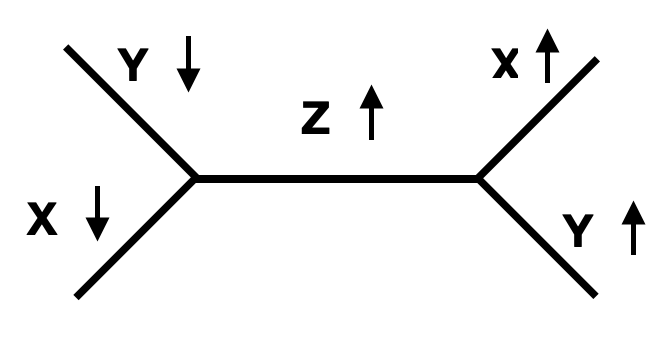
I will explain some exploration of models using this structure, but for now also point out one drawback that should be remedied.